Why Zero Trust Security Is a Must for Modern SMB IT Strategy
As the digital world gets more complicated, so do the threats to their data and systems. Today, cybercriminals are no longer just focused on huge companies; they’re increasingly targeting SMBs because they know their defenses might be weaker.
That’s where zero trust security comes in. In this blog, we’ll discuss why adopting a zero trust architecture is now a critical part of a smart business strategy.
The Rising Threat to SMBs
Imagine a small e-commerce business wakes up to find its customer database compromised, with sensitive information like credit card details leaked on the dark web. Today, this can be a reality for many SMBs. According to a recent IBM report, the average cost of a data breach in India has risen to ₹22 crore (approximately $2.68 million USD) in 2025, marking a 13% increase from the previous year. Unlike large corporations with deep pockets, a single breach can cripple a small business, leading to lost revenue, damaged reputation, and even closure.
Why are SMBs such prime targets? Cybercriminals know that smaller organizations often lack the sophisticated IT security that larger enterprises deploy. Similarly, in an era of hybrid work, cloud computing, and bring-your-own-device (BYOD) policies, the traditional security defenses are like locking the front door while leaving the windows wide open.
What Is Zero Trust Security?
At its core, zero trust security operates on a simple yet powerful principle: trust no one, verify everyone. Unlike traditional security models that assume everything inside a network is safe, zero trust architecture treats every user, device, and connection as a potential threat until proven otherwise. This approach requires continuous authentication and validation, regardless of whether the access request comes from inside or outside the network.
This granular approach, often implemented through network access control, makes it exponentially harder for attackers to move laterally within your systems.
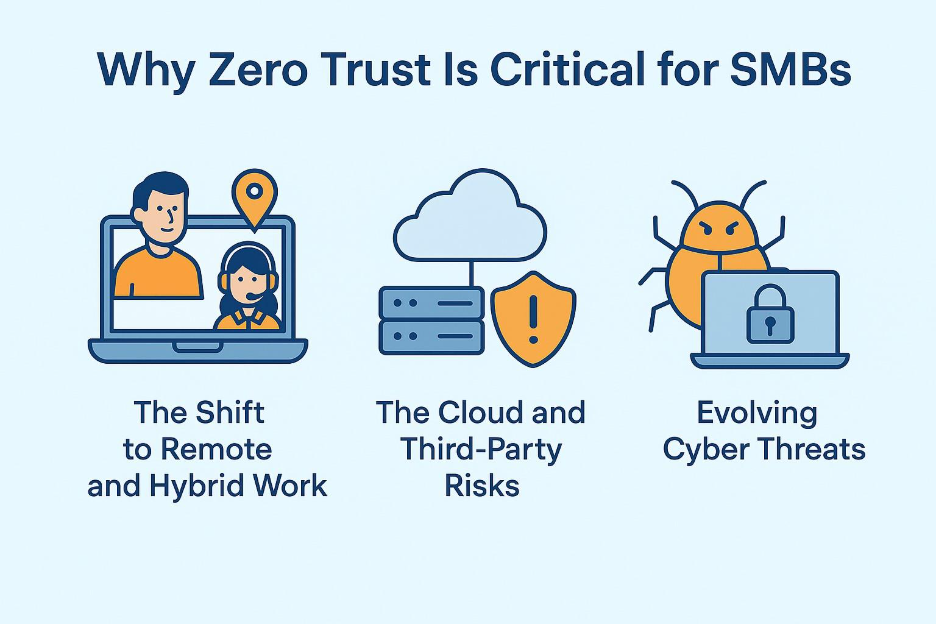
Why Zero Trust Is Critical for SMBs
1. The Shift to Remote and Hybrid Work
The pandemic accelerated the adoption of remote work, and for many SMBs, this shift is here to stay. Employees now access company systems from home Wi-Fi, coffee shops, or even public networks. However, each connection point is a potential vulnerability. A 2022 study by Cisco found that 60% of SMBs experienced an increase in cyber threats due to remote work.
Zero trust security addresses this by requiring every user to authenticate their identity and device before accessing sensitive resources. Tools like multi-factor authentication (MFA), single sign-on (SSO), and endpoint security verify that only authorized users on trusted devices can connect, no matter where they are. For SMBs, this means employees can work flexibly without compromising IT security.
2. The Cloud and Third-Party Risks
SMBs increasingly rely on cloud-based services or industry-specific SaaS platforms. While these tools boost productivity, they also introduce new risks. Each third-party service is a potential entry point for attackers, especially if not properly secured.
Zero trust architecture mitigates these risks by enforcing strict network access control. It limits access to only what’s necessary for each user’s role, a principle known as least privilege. For example, a marketing intern doesn’t need access to financial records, and a vendor shouldn’t have free rein over your entire cloud environment. By segmenting access, zero trust minimizes the damage an attacker can do, even if they breach one system.
3. Evolving Cyber Threats
Cybercriminals are getting smarter. Phishing attacks, ransomware, and insider threats are more sophisticated than ever. A single compromised password can give attackers a foothold, and SMBs, with their limited IT staff, often struggle to keep up. The 2023 Data Breach Investigations Report noted that 74% of breaches involved human error, such as clicking on malicious links.
Zero trust security counters this by assuming breaches are inevitable. Instead of focusing solely on prevention, it emphasizes detection and containment. Continuous monitoring and real-time analytics flag suspicious behaviour, like an employee logging in from an unusual location or a device attempting unauthorized access. For SMBs, this proactive stance can mean the difference between a minor incident and a catastrophic breach.
Implementing Zero Trust in Your SMB
The good news is that zero trust is scalable and doesn’t require a complete overhaul of your systems. Here’s how to get started:
Step 1: Assess Your Current Security Posture
Begin by mapping out your IT environment. Identify all users, devices, applications, and data flows. Tools like network scanners can help you discover shadow IT—unauthorized apps or devices that employees might be using. Understanding your attack surface is the foundation of IT security.
Step 2: Implement Strong Identity Verification
Identity is the cornerstone of zero trust. Therefore, deploy MFA across all accounts to add an extra layer of protection. Various providers offer affordable, SMB-friendly options for managing identities and enforcing network access control.
Step 3: Embrace Least Privilege Access
Limit access to sensitive resources based on roles and responsibilities. For example, use role-based access control (RBAC) to grant employees only the permissions they need to do their jobs. Similarly, regularly audit access rights to prevent privilege creep, where employees accumulate unnecessary permissions over time.
Step 4: Secure Devices and Endpoints
Every device connecting to your network is a potential weak point. Therefore, use endpoint protection platforms (EPPs) to monitor and secure devices, whether company-owned or BYOD.
Step 5: Monitor and Respond in Real Time
Zero trust thrives on visibility. Hence, invest in a security information and event management (SIEM) system to monitor network activity and detect anomalies.
Step 6: Educate Your Team
Your employees are your first line of defense. Train them to recognize phishing emails, use strong passwords, and follow security best practices. Regular training sessions and simulated phishing attacks can keep your team vigilant.
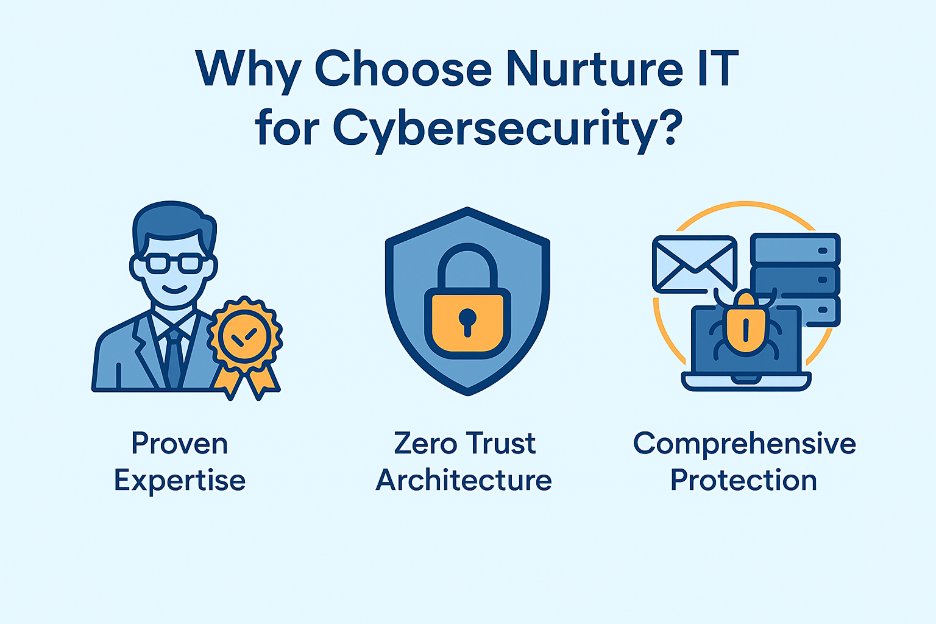
Why Choose Nurture IT for Cybersecurity?
At Nurture IT, we’ve crafted zero trust security solutions that are affordable, scalable, and designed to protect your business without complexity. Here’s what sets us apart:
- Proven Expertise: With over 20+ years of delivering top-tier IT infrastructure solutions, we’ve earned the trust of businesses across India and beyond. Our clients, from startups to established firms, praise our quick turnaround times and customized approaches.
- Zero Trust Architecture: We implement zero-trust security, so no user or device is trusted by default. Every access request is verified, minimizing risks from phishing, ransomware, and insider threats.
- Comprehensive Protection: From network access control to endpoint security, our solutions cover every layer of your IT environment, safeguarding your data, devices, and applications.
Final Thoughts
By prioritizing IT security for small businesses, leveraging network access control, and embracing zero trust security, you can protect your business, build customer trust, and stay ahead of the curve.
Let Nurture IT be your trusted partner in building a secure, resilient future for your business.
FAQs
1. How does zero trust architecture differ from traditional security models?
Unlike traditional models that rely on perimeter defenses like firewalls, zero trust architecture verifies every access request, regardless of whether it comes from inside or outside the network. It uses principles like least privilege and continuous monitoring to reduce vulnerabilities.
2. How does zero trust security support remote work for SMBs?
Zero trust security uses tools like multi-factor authentication (MFA) and endpoint security to verify users and devices accessing systems from any location, reducing risks from unsecured networks like home Wi-Fi or public hotspots.
3. What role does network access control play in zero trust for SMBs?
Network access control limits access to resources based on user roles and device status, enforcing least privilege principles. It prevents unauthorized access and minimizes the damage an attacker can do if they breach one part of the system.
4. What are the first steps for an SMB to adopt zero trust security?
Start by assessing your IT environment to identify users, devices, and data flows. Then implement MFA, enforce least privilege access, secure endpoints, and use monitoring tools to detect threats, gradually building a zero trust security framework.