
IT Ops Management
Today, businesses are more reliant on their IT systems than ever before. However, as companies grow, so does the intricacy of managing their IT operations. That’s where IT Ops management comes in, the backbone of your entire IT infrastructure.
But what is IT Ops management, and why does it matter so much for modern businesses? Here, we’ll take a closer look at IT Ops management, why it matters, its key components, and best practices.
What is IT Ops Management?
IT Ops management focuses on managing and optimizing the IT systems and services within an organization. This includes everything from servers, networks, and storage systems to the software applications that power daily operations. IT Ops management aims to keep IT services available, efficient, and secure for users and customers.
The goal of IT Ops management is to reduce downtime, keep operations running smoothly, and address problems before they impact productivity.
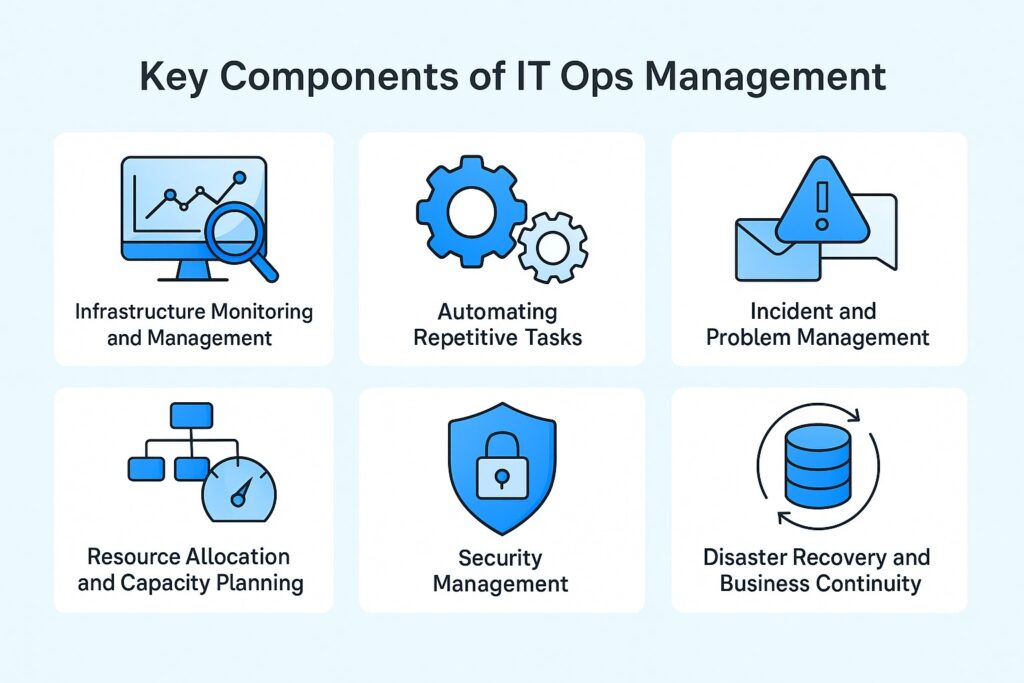
Key Components of IT Ops Management
Below are the key components of IT Ops management:
1. Infrastructure Monitoring and Management
Monitoring is the first step in IT Ops management. It involves keeping an eye on the performance and availability of IT systems like servers, databases, and networks. By monitoring these, IT teams can spot issues such as system overloads, network failures, or security risks.
With modern tools, monitoring not only tracks performance but also provides real-time insights into resource usage and traffic. This helps IT teams make better decisions about scaling and planning for future needs.
2. Automating Repetitive Tasks
Managing IT operations manually can be time-consuming. That’s where automation helps. Tasks like software updates, system configurations, and security patching can be automated to free up time for IT teams.
Automation also reduces human errors and boosts efficiency. For example, tasks like system backups or cloud scaling can be scheduled to run during off-peak hours, keeping systems running smoothly without interruption.
3. Incident and Problem Management
Every IT system faces problems from time to time. Whether it’s a slow network or a system crash, these issues can disrupt the flow of business operations. IT Ops management teams are responsible for quickly resolving such issues.
In addition to incident management, problem management is another critical aspect of IT Ops management. While incident management focuses on solving immediate issues, problem management aims to identify the root cause of recurring issues and implement long-term fixes.
4. Resource Allocation and Capacity Planning
A core function of IT Ops management is to allocate resources such as bandwidth, storage, and computing power as needed by demand. By analyzing past data and forecasting future needs, IT teams can make adjustments to resources as those needs evolve.
Capacity planning helps businesses avoid over-provisioning or under-provisioning their IT systems. Over-provisioning leads to wasted resources and unnecessary costs, while under-provisioning can lead to system crashes or slowdowns during peak usage times.
5. Security Management
Cybersecurity is an ever-growing concern for organizations. Therefore, IT Ops management teams monitor systems for vulnerabilities, deploy patches, and actively update all security measures. Regular audits and real-time monitoring tools help identify any potential threats and mitigate them before they cause significant damage.
Moreover, IT Ops management plays a crucial role in enforcing company policies and compliance standards. Whether it’s managing user access controls or encrypting sensitive data, IT Ops teams work to keep the systems secure from both internal and external threats.
6. Disaster Recovery and Business Continuity
A disaster recovery plan (DRP) is key to minimizing downtime during emergencies. IT Ops management focuses on developing and testing strategies like data backups, system replication, and failover mechanisms. These measures help your business quickly recover with minimal disruption if a system failure occurs.
Business continuity is equally important in IT Ops management. By regularly assessing risks and preparing for unexpected events, IT teams work to keep critical systems running smoothly, even when facing challenges like cyberattacks.
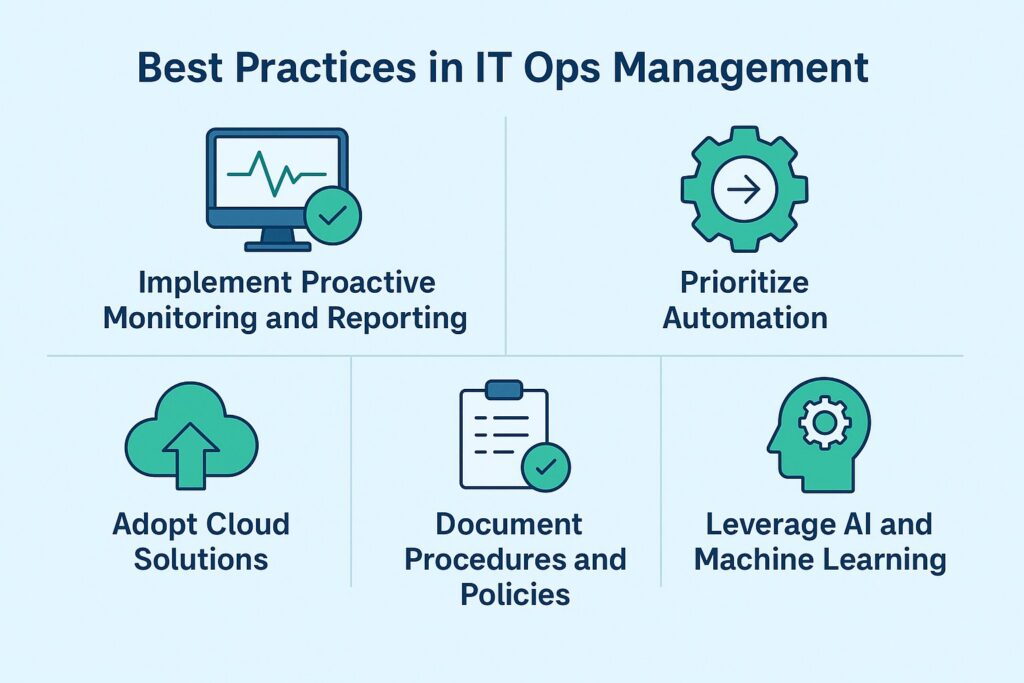
Best Practices in IT Ops Management
Now that we’ve covered the key components, let’s look at some best practices that can help organizations manage their IT operations.
1. Implement Proactive Monitoring and Reporting
Instead of waiting for issues to arise, proactive monitoring helps detect potential problems before they become critical. To address issues promptly, IT Ops teams need to implement tools that provide real-time alerts.
2. Adopt Cloud Solutions
Cloud solutions can simplify IT operations by offering scalable, flexible resources. By leveraging cloud-based platforms, businesses can reduce hardware-related expenses and improve accessibility. Cloud solutions also support remote work and can be integrated seamlessly with existing IT infrastructure.
3. Prioritize Automation
Automating routine tasks like patch management, backups, and system monitoring can significantly reduce the workload on IT teams. Automation frees up valuable resources for innovation and troubleshooting.
4. Document Procedures and Policies
Clear documentation of IT procedures, security policies, and recovery plans can streamline operations, especially when teams are under pressure. During critical events, well-documented procedures lead to quick issue fixes and collective understanding.
5. Leverage AI and Machine Learning
The use of AI and machine learning in IT Ops management can enhance the efficiency of monitoring, predictive analytics, and incident management. These technologies can help anticipate problems and automate routine tasks, leading to improved system performance and reduced downtime.
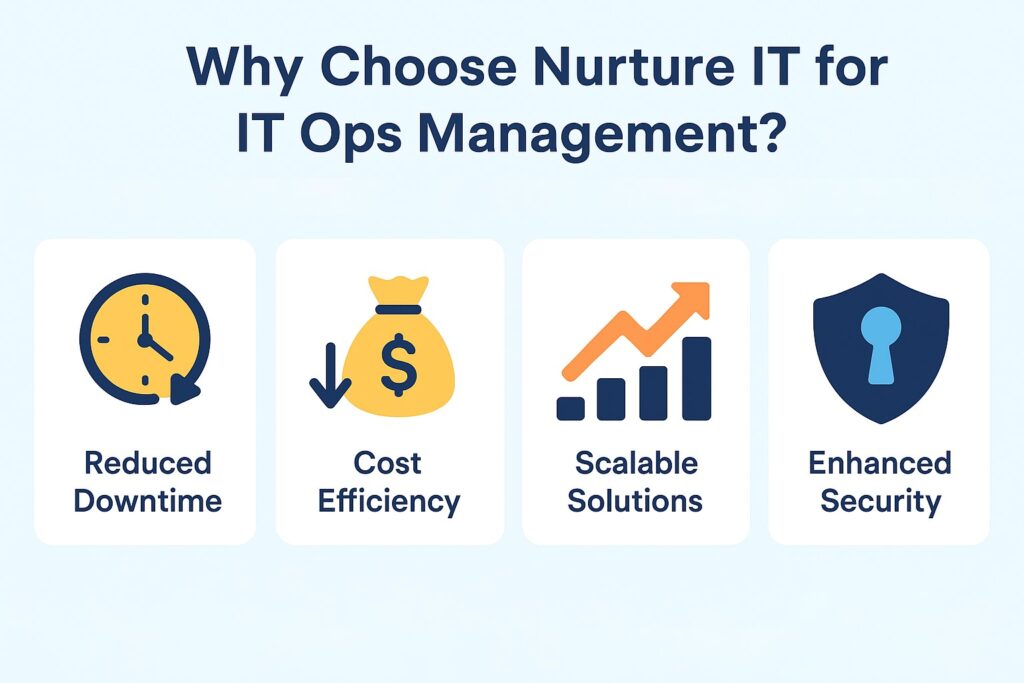
Why Choose Nurture IT for IT Ops Management?
At Nurture IT, our expert team handles the day-to-day management of your IT operations, from infrastructure monitoring and incident management to resource allocation and security management.
How We Deliver Value
- Reduced Downtime: With continuous monitoring and proactive issue resolution, we minimize IT disruptions, so your business stays productive.
- Cost Efficiency: Through automation and resource optimization, we help reduce IT overhead, saving you time and money.
- Scalable Solutions: As your business grows, we adapt your IT systems to meet evolving demands, helping you scale without interruptions.
- Enhanced Security: We focus on protecting your infrastructure, so that your systems are resilient against potential threats.
Final Thoughts
As organizations grow and depend more on their IT infrastructure, the need for robust management strategies becomes even more critical. By adopting the right technologies, tools, and practices, businesses can minimize downtime, improve system performance, and drive business growth.
Contact Nurture IT today and take the first step toward more streamlined, secure, and reliable IT operations.
FAQs
1. What are the key components of IT Ops management?
Key components include infrastructure monitoring, automation, incident management, resource allocation, security management, and disaster recovery.
2. How does IT Ops management contribute to business continuity?
By continuously monitoring systems and addressing issues before they escalate, IT Ops management reduces the risk of disruptions, ensuring continuous business operations.
3. How can IT Ops management help with cost savings?
By optimizing IT resources, automating routine tasks, and preventing unnecessary system failures, IT Ops management helps businesses cut costs and maximize resource utilization.
4. Why is IT Ops management important for businesses?
IT Ops management helps businesses maintain operational efficiency by monitoring systems, resolving issues promptly, optimizing resources, and safeguarding against security threats.
5. What is disaster recovery in IT Ops management?
Disaster recovery refers to plans and strategies that help organizations recover quickly from IT disruptions, minimizing downtime and maintaining business operations during emergencies.