

How Startups in Bangalore Can Build a Cost-Effective Hybrid Cloud Infrastructure
Startups often face the challenge of balancing rapid growth with limited budgets, especially when it comes to IT infrastructure. Cloud computing provides the flexibility and scalability needed, but relying solely on public or private cloud environments can be cost-intensive. However, a hybrid cloud approach, which combines on-premises infrastructure with public cloud resources, offers a strategic solution for startups looking to optimize performance while controlling costs.
In this blog, we’ll discuss how startups can build a cost-effective hybrid cloud infrastructure with the support of IT service provider companies.
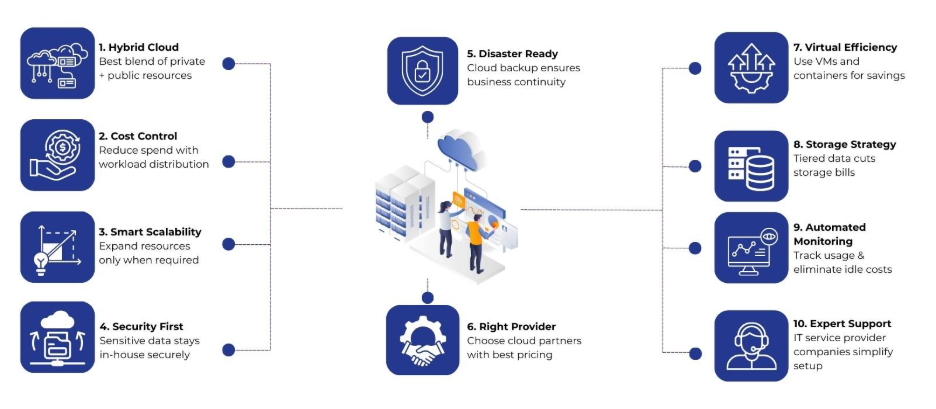
What Is Hybrid Cloud Infrastructure?
Hybrid cloud infrastructure integrates private cloud environments, like on-premises servers or private data centres, with public cloud services from providers like Microsoft Azure. This model allows startups to leverage the best of both worlds: the security and control of private clouds and the scalability and cost-effectiveness of public clouds.
For startups, a hybrid cloud approach can accommodate fluctuating workloads, reduce upfront hardware investments, and provide better disaster recovery options.
Why Startups Should Consider Hybrid Cloud Solutions
Scalability on Demand
Startups often experience unpredictable growth. Hybrid cloud environments allow companies to expand computing resources quickly without committing to permanent hardware purchases. As a result, startups can run core applications on private infrastructure while scaling high-demand workloads in the public cloud.
Cost Efficiency
Building an entirely private cloud is capital-intensive, while relying fully on public cloud services may result in higher operational expenses. Hybrid cloud architecture allows startups to balance costs by keeping steady workloads on private servers and offloading peak workloads to public cloud resources.
Improved Security and Compliance
Startups handling sensitive data can store critical information in private clouds while utilizing public clouds for less sensitive operations. This separation helps maintain security standards, comply with data regulations, and reduce the risk of breaches.
Business Continuity and Disaster Recovery
Hybrid cloud environments facilitate robust disaster recovery strategies. Public cloud storage can act as a backup for private servers, minimizing downtime during hardware failures or unexpected outages.
Steps to Build a Cost-Effective Hybrid Cloud Infrastructure
1. Assess Business Needs and Workloads
Before investing in hybrid cloud solutions, startups should perform a detailed assessment of business needs and workloads. Identify applications that are critical, data sensitivity levels, and performance requirements.
By categorizing workloads into high-priority, sensitive, or seasonal, startups can decide which resources should remain on private infrastructure and which can leverage public cloud scalability. Consulting with IT service provider companies can help map workloads efficiently and identify cost-saving opportunities.
2. Choose the Right Cloud Service Providers
Selecting public cloud providers is a crucial step. Therefore, evaluate providers based on pricing models, service-level agreements (SLAs), geographic availability, and compatibility with existing systems. Many public cloud providers offer pay-as-you-go or reserved instances, which can significantly reduce operational costs.
For private cloud deployment, startups should choose a scalable infrastructure to avoid excessive upfront investment.
3. Implement Virtualization and Containerization
Virtualization allows startups to maximize resource utilization by running multiple virtual machines on a single physical server. Containerization, using tools like Docker and Kubernetes, further enhances efficiency by enabling applications to run consistently across private and public clouds.
These technologies reduce hardware costs, simplify deployment, and improve overall resource management, making hybrid cloud infrastructure more cost-effective.
4. Optimize Storage and Networking Costs
Storage is a big component of cloud expenditure. Startups can adopt a tiered storage approach, keeping frequently accessed data on high-performance private servers while storing less critical information in cost-effective public cloud storage.
Similarly, networking expenses can be minimized by strategically placing workloads closer to end-users and leveraging bandwidth management tools. IT service provider companies can advise on network architecture that balances speed, cost, and reliability.
5. Automate Management and Monitoring
Hybrid cloud environments require ongoing monitoring and management to maintain efficiency. Automation tools can help startups manage workloads, allocate resources dynamically, and monitor performance.
By setting up automated alerts, startups can detect underutilized resources or potential bottlenecks and reduce operational costs. Many public cloud platforms provide built-in monitoring tools, and third-party solutions can integrate across private and public environments.
6. Adopt a Cloud Cost Optimization Strategy
Cost optimization is critical for startups. Therefore, regularly reviewing usage patterns, shutting down idle resources, and choosing the most cost-effective instance types can significantly reduce cloud bills.
IT service provider companies like Nurture IT in Indiranagar can conduct cloud audits to identify inefficiencies and suggest optimizations tailored to startup budgets.
7. Leverage Security Best Practices
Security is a priority for startups operating in hybrid cloud environments. Encrypting sensitive data, implementing strict access controls, and conducting periodic security audits protect against breaches and reduce long-term costs related to security incidents.
Public cloud providers offer integrated security tools, but combining them with private cloud controls provides comprehensive protection for critical workloads.
8. Plan for Scalability and Future Growth
Hybrid cloud infrastructure should be designed with growth in mind. Startups need systems that can accommodate increasing workloads, new applications, and evolving business requirements without large capital expenditure.
Modular architecture and flexible service contracts from public cloud providers allow startups to scale efficiently. When you partner with experienced IT providers like Nurture IT, you can align your growth planning with the right technology investments and your budget.
How Nurture IT Supports Startups with Hybrid Cloud Infrastructure
At Nurture IT, we play a key role in helping startups build and maintain cost-effective hybrid cloud infrastructure. Our expertise covers every aspect of hybrid cloud management, including:
- Designing architectures that strike the perfect balance between performance and cost
- Selecting the right mix of public cloud providers and private infrastructure solutions
- Implementing robust security, monitoring, and compliance protocols
- Providing ongoing support, performance optimization, and troubleshooting
For startups without in-house IT teams, Nurture IT delivers end-to-end hybrid cloud solutions, so your business can focus on growth while we manage your IT infrastructure efficiently.
Contact us today and let’s build your future-ready infrastructure together!
FAQs
1. What is a hybrid cloud infrastructure?
A hybrid cloud infrastructure combines private on-premises servers with public cloud services, allowing startups to balance security, scalability, and cost-efficiency.
2. Why should startups consider hybrid cloud solutions?
Hybrid cloud provides startups with flexibility to scale resources, reduce upfront hardware costs, improve security, and maintain business continuity.
3. Which workloads are best suited for private vs. public cloud?
Critical or sensitive applications are better on private infrastructure, while fluctuating or high-demand workloads can leverage the public cloud for scalability.
4. How can startups save costs with hybrid cloud architecture?
Startups can reduce expenses by running steady workloads on private servers and offloading peak or seasonal workloads to public cloud resources.
5. What role do IT service provider companies like Nurture IT play?
We design hybrid cloud architectures, select the right infrastructure, implement security and monitoring protocols, and provide ongoing optimization and support.