Cost Considerations When Selecting an IT Infrastructure Service Provider
Choosing the right IT infrastructure service provider is one of the most important decisions a business can make. It affects not only operational efficiency but also long-term financial performance. When evaluating potential vendors, cost is a big deal — but it’s not just about finding the cheapest option. Businesses must weigh initial expenses, ongoing costs, scalability, and the total value delivered over time.
Below, we’ll break down the main cost considerations every company should review before partnering with an IT infrastructure provider.
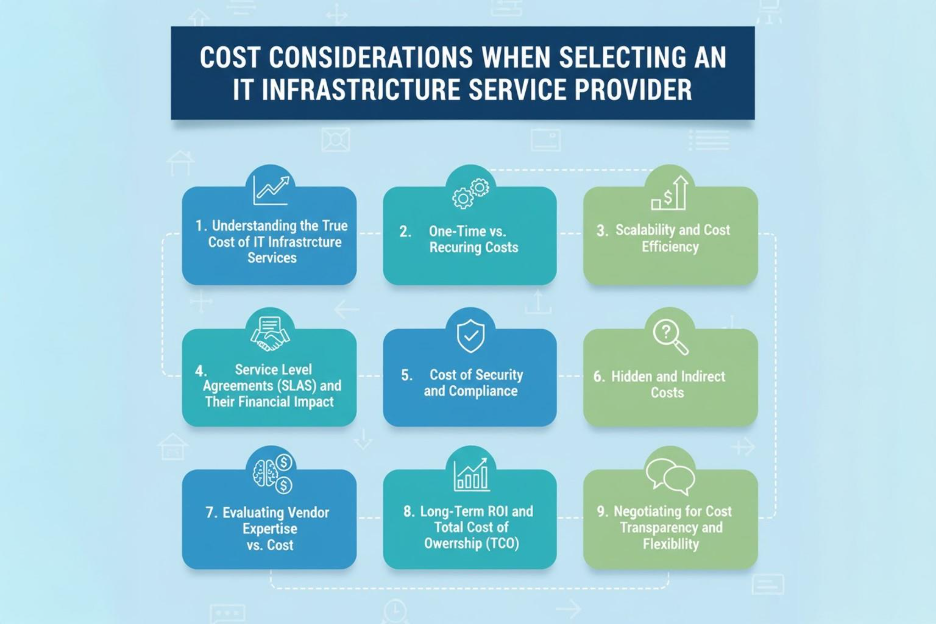
1. Understanding the True Cost of IT infrastructure service provider
When assessing proposals from IT infrastructure providers, businesses often focus only on upfront pricing. However, true cost extends beyond the first invoice. It includes:
- Setup and installation costs: Expenses for configuring hardware, software, and network systems.
- Training costs: Teams may need onboarding to understand new systems.
- Maintenance and upgrade fees: Regular system updates, patches, and performance improvements.
Understanding these categories helps companies avoid unexpected financial burdens later. Also, a transparent pricing model gives you clarity on what you’re paying for — and when.
2. One-Time vs. Recurring Costs
Most IT infrastructure solutions come with both one-time and recurring costs. Knowing how each impacts your budget can help prevent future surprises.
- One-Time Costs
These are typically upfront investments like hardware purchase, installation, or migration. If a business opts for an on-premises setup, one-time costs may be higher because of the equipment.
- Recurring Costs
Recurring expenses come from subscription models, cloud usage, or managed services. A cloud-based IT infrastructure provider may charge monthly or yearly fees based on storage, bandwidth, or the number of users. While recurring costs appear smaller, they can add up over time and should be reviewed carefully in long-term contracts.
3. Scalability and Cost Efficiency
Scalability directly impacts cost efficiency. As businesses grow, their IT demands — storage, bandwidth, user access — also expand. The best IT infrastructure provider offers flexible plans that scale without major disruptions or costs.
When assessing scalability-related costs, consider
- Pay-as-you-grow pricing: Allows businesses to expand infrastructure without paying for unused capacity.
- Load balancing: Avoids paying for idle resources during low demand.
- Integration costs: Adding new applications or users shouldn’t require a full system overhaul.
A scalable provider helps balance performance and cost while adapting to business fluctuations.
4. Service Level Agreements (SLAs) and Their Financial Impact
An SLA defines performance guarantees like uptime, response time, and issue resolution. While vendors with high SLA guarantees might charge more, the cost is justified if it minimizes downtime.
Key SLA-Related Cost Factors
- Downtime penalties: Understand how much downtime the provider allows and what compensation applies if it exceeds limits.
- Support levels: 24/7 support typically costs more, but it reduces risk during emergencies.
- Incident response times: Faster response options may come at a premium.
Choosing an IT infrastructure provider with a clear SLA protects your operations and finances from unexpected disruptions.
5. Cost of Security and Compliance
Security and compliance are critical parts of IT infrastructure costs.
Data breaches or non-compliance fines can easily exceed any cost savings.
Therefore, when comparing providers, evaluate the financial coverage for:
- Data encryption and protection protocols
- Firewall, intrusion detection, and antivirus tools
- Compliance with the DPDP Act or IT SPD Rules
- Regular vulnerability assessments and audits
However, it’s better to invest slightly more in a provider that maintains high security standards than to risk losses from a single data incident.
6. Hidden and Indirect Costs
Beyond the quoted price, indirect costs can affect the total ownership experience.
These often include:
- Migration expenses: Moving from an old system to a new infrastructure can require additional setup or downtime.
- Vendor lock-in costs: Some IT infrastructure providers make it costly or complicated to switch later.
- Performance limitations: Lower-tier plans might restrict bandwidth or processing speed, leading to operational delays.
- Custom integrations: Connecting the infrastructure with existing ERP, CRM, or accounting systems might incur custom development charges.
A transparent conversation about hidden costs before signing a contract can save significant money later.
7. Evaluating Vendor Expertise vs. Cost
While price is critical, choosing solely based on the lowest quote can backfire. The expertise and experience of an IT infrastructure provider influence long-term value.
Factors worth paying for include:
- Proven industry experience: Vendors familiar with your industry understand compliance and performance needs better.
- Dedicated support teams: Reliable communication channels reduce problem-solving delays.
- Use of modern technologies: Providers using virtualization, automation, and AI-driven monitoring deliver higher efficiency per dollar spent.
Balancing cost with vendor reliability helps prevent technical debt and future migration expenses.
8. Long-Term ROI and Total Cost of Ownership (TCO)
To truly measure the cost of IT infrastructure, look beyond the initial investment and calculate the Total Cost of Ownership (TCO). This includes setup, maintenance, energy consumption, scalability, and support.
A cost-effective IT infrastructure provider helps reduce manual intervention, improve uptime, and increase system productivity. Over time, this improves ROI by cutting downtime losses, reducing maintenance costs, and enhancing system longevity.
Formula for TCO Evaluation
TCO = (Initial Setup + Recurring Costs + Maintenance + Downtime Costs + Exit Costs)
By comparing TCO across vendors, you get a clearer picture of long-term financial impact — far beyond monthly fees.
9. Negotiating for Cost Transparency and Flexibility
Before finalizing a contract, businesses should negotiate for cost transparency.
Key negotiation points include:
- Itemized pricing structure: Request detailed breakdowns for each service.
- Flexible upgrade/downgrade policies: Prevent overpayment for unused capacity.
- Trial periods or pilot projects: Test services before full-scale commitment.
- Exit terms: Understand data migration and termination fees upfront.
Transparent and flexible pricing agreements allow companies to adapt budgets as business priorities change.
Final Thoughts
Cost analysis isn’t just about finding the cheapest IT partner — it’s about choosing the one that adds measurable value. A dependable IT infrastructure provider like Nurture IT offers clarity in pricing, transparent SLAs, scalability options, and ongoing support that justify the investment.
Contact us today to explore how we can help streamline your IT infrastructure and drive growth.
FAQs
1. What factors should I consider when selecting an IT infrastructure provider?
When selecting an IT infrastructure provider, it’s important to assess setup costs, recurring fees, scalability, support levels, security, compliance, and overall long-term value.
2. How do one-time and recurring costs differ in IT infrastructure services?
One-time costs typically cover setup, hardware, and installation, while recurring costs involve subscription fees, cloud usage, and ongoing maintenance.
3. Why is scalability important when choosing an IT infrastructure provider?
Scalability allows businesses to adjust infrastructure as needed without incurring large extra costs, making it easier to grow and adapt without major disruptions.
4. How can SLAs impact the cost of IT infrastructure services?
SLAs define performance guarantees like uptime and response time, and higher guarantees can increase costs but provide better support and reliability.