Best Practices in IT Operations 2025
As technology continues to advance, IT operations are undergoing significant shifts. Businesses continually seek ways to optimize their IT operations, enhance efficiency, and meet increasing customer demands. Therefore, IT operations management (IT ops management) will be more critical than ever, with organizations focusing on automation, cloud solutions, and proactive strategies to enhance their IT infrastructure.
In this blog, we’ll discuss the best practices in IT operations for 2025, covering everything from automation to security, and how these trends are shaping the future of IT.
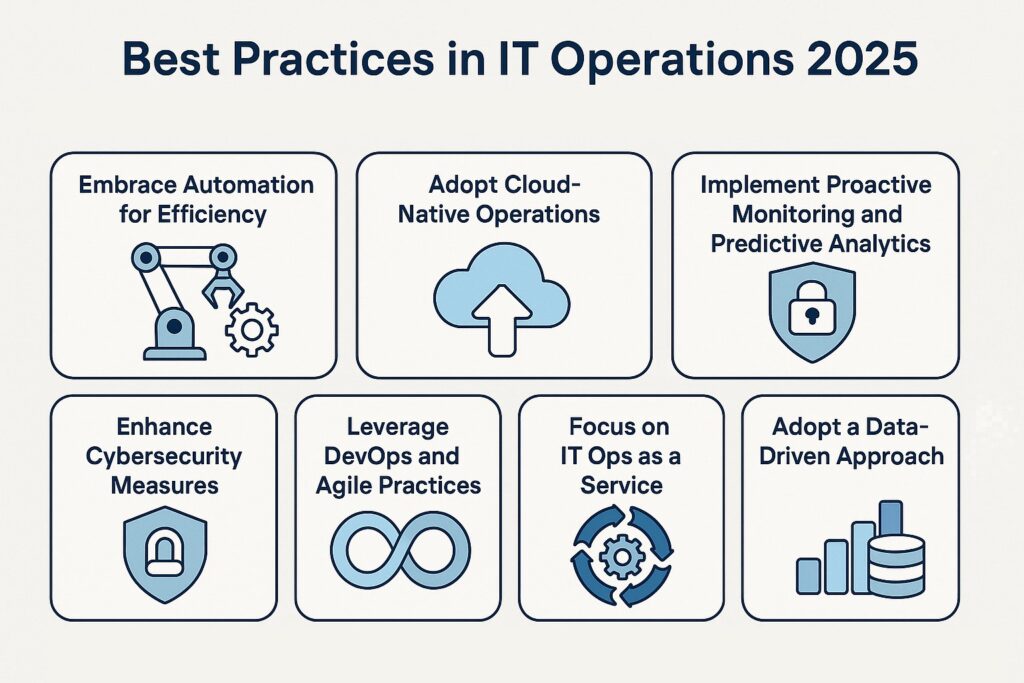
1. Embrace Automation for Efficiency
Automation has become a key trend in IT ops management and is expected to grow. By automating routine tasks, businesses can reduce human error, streamline operations, and free up IT teams to focus on more strategic projects. Companies can apply automation tools across various aspects of IT, from network management and incident response to software deployment and system monitoring.
How Automation Drives IT Operations
- Improved efficiency: Automating repetitive tasks such as patching, updates, and system health checks cuts down the time IT teams spend on manual efforts.
- Faster incident resolution: Automation quickly identifies and resolves issues by triggering predefined actions as soon as it detects a problem.
- Enhanced scalability: Automation scales easily with business growth, so IT operations stay efficient as the infrastructure expands.
2. Adopt Cloud-Native Operations
Cloud technology continues to be a game-changer in IT ops management. As businesses transition from traditional on-premises setups to cloud-native infrastructures, IT teams must adapt their operations to fully leverage the flexibility, scalability, and cost savings that the cloud offers.
Key Benefits of Cloud-Native Operations
- Cost efficiency: With cloud computing, businesses pay for resources only as they use them, cutting costs significantly compared to maintaining physical hardware.
- Scalability: Cloud-based systems automatically scale based on demand, so that businesses can handle traffic spikes and growing customer needs without manual intervention.
- Disaster recovery: Cloud environments provide built-in redundancy, which reduces the risk of data loss in the event of a system failure.
3. Implement Proactive Monitoring and Predictive Analytics
Today, businesses can no longer afford to take a reactive approach to IT operations. With the increasing complexity of IT infrastructures and the need for seamless customer experiences, IT teams must be able to predict and prevent issues before they impact operations.
The Power of Proactive Monitoring
- Real-time insights: Advanced monitoring systems can track system performance, network traffic, and application behavior in real-time, providing IT teams with the data they need to make quick decisions.
- Predictive analytics: By leveraging machine learning and AI, predictive analytics tools can identify potential failures or bottlenecks before they happen, allowing teams to take corrective action.
- Enhanced security: Proactive monitoring also enables businesses to detect and mitigate security threats before they cause significant damage.
4. Enhance Cybersecurity Measures
Cybersecurity remains a top priority in IT ops management, and as we move into 2025, securing IT environments will require a more holistic and integrated approach.
Key Cybersecurity Practices for 2025
- Zero-trust architecture: In a zero-trust model, businesses never trust any device or user by default, whether inside or outside the network. Every access request is verified, which minimizes the risk of unauthorized access.
- AI and machine learning for threat detection: AI-driven security tools can identify unusual patterns of behaviour and potential threats faster than traditional systems.
- Automated security response: By quickly isolating compromised systems, security automation tools prevent further damage and minimize incident response time.
Companies like Google and Microsoft are leading the way in implementing zero-trust architectures.
5. Leverage DevOps and Agile Practices
DevOps and Agile methodologies have revolutionized IT operations by breaking down the silos between development and operations teams. By embracing DevOps and Agile in IT ops management, organizations can achieve faster software delivery, improved collaboration, and greater alignment with business goals.
How DevOps and Agile Improve IT Operations
- Faster software development: By using Agile sprints and continuous integration/continuous deployment (CI/CD) pipelines, businesses can develop and deploy software more quickly and reliably.
- Better collaboration: DevOps emphasizes communication between development, operations, and security teams, so that everyone is on the same page when delivering quality software.
- Continuous improvement: Agile practices allow IT teams to iteratively improve their systems, responding to feedback and adjusting as necessary to meet customer needs.
Companies like Amazon and Facebook have used DevOps and Agile practices to drive rapid development and innovation, allowing them to stay ahead in a highly competitive market.
6. Focus on IT Ops as a Service
IT as a Service (ITaaS) is becoming an increasingly popular model for businesses looking to outsource IT management tasks to external service providers. By adopting an ITaaS model, organizations can focus on their core business while experts handle IT infrastructure, software, and security management.
Benefits of IT Ops as a Service
- Cost savings: ITaaS reduces the need for in-house IT teams, which lowers operational costs.
- Expertise: Service providers bring specialized knowledge and experience to help businesses optimize their IT infrastructure.
- Scalability: ITaaS providers offer flexible solutions that scale with business needs, allowing for seamless growth and adaptation.
7. Adopt a Data-Driven Approach
Data is at the core of IT ops management in 2025. By leveraging data analytics, businesses can gain insights into their IT performance, identify areas for improvement, and make informed decisions.
The Role of Data in IT Ops Management
- Performance optimization: Data analytics can pinpoint inefficiencies in IT operations, enabling teams to identify bottlenecks and refine workflows.
- Cost management: By analyzing usage patterns and trends, businesses can optimize their IT spending and avoid unnecessary expenses.
- Risk management: Data helps businesses identify potential risks, such as system vulnerabilities or performance degradation, allowing IT teams to address these issues proactively.
Final Thoughts
As we move further, IT ops management will continue to evolve, with a greater emphasis on automation, cloud solutions, and data-driven decision-making. By adopting these best practices, businesses can optimize their IT operations, enhance efficiency, and adapt to the ever-evolving digital landscape.
About Nurture IT
Nurture IT, one of the leading IT service providers in Bangalore, offers customized scalable technology solutions to accelerate growth, reduce costs, and enable collaboration. As a preferred partner to technology leaders like Microsoft and Cisco, we deploy the most advanced business technology solutions to ensure optimal reliability, productivity, and value.
Our B2B branch, Nurture IT, adeptly serves corporate and scaling-up demands. Conversely, for those not anticipating immediate growth, our Retail division – Laptop World caters to your specific needs. Make an informed choice that aligns with your organizational trajectory and immediate needs.
FAQs
- How does automation play a role in IT ops management?
Automation in IT ops management helps streamline repetitive tasks, reduce human error, and improve operational efficiency by allowing businesses to quickly deploy patches, updates, and resolve incidents without manual intervention.
- What are the key benefits of IT ops management in cybersecurity?
IT ops management helps improve cybersecurity by providing tools for proactive threat detection, automating security responses, and implementing frameworks like zero-trust to protect against unauthorized access.
- How does proactive monitoring contribute to IT ops management?
Proactive monitoring in IT ops management helps identify and address potential issues before they impact systems, so that businesses can minimize downtime and optimize system performance.
- How does IT ops management support data-driven decision-making?
IT ops management supports data-driven decision-making by providing insights into system performance, usage patterns, and potential risks, so that businesses can optimize operations and make informed decisions based on real-time data.