Small Business Guide to Choosing the Right IT Support Model (In-House vs Outsourced)
Technology is the backbone of a small business today. It’s what keeps customer info organized, keeps the books balanced, and helps teams stay connected and safe online, no matter where they’re working. However, maintaining reliable IT systems requires choosing the right IT support model.
This breakdown of in-house vs. outsourced IT gives small business owners the facts they need to weigh up costs against real-world value. Choosing the right model can influence productivity, scalability, cybersecurity readiness, and operational efficiency.
Understanding IT Support Models for Small Businesses
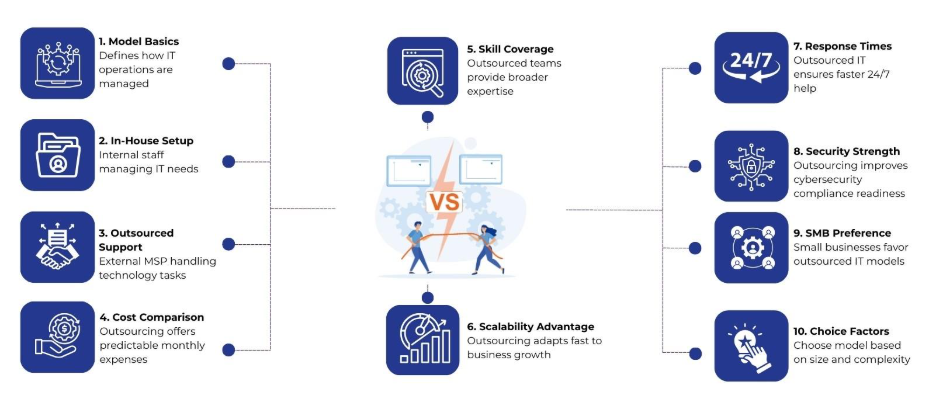
An IT support model defines how a business manages its technology infrastructure, troubleshooting, maintenance, and security.
Common IT Support Models Include:
In-house IT support: Hiring internal staff to manage IT needs
Outsourced IT support: Partnering with a third-party managed service provider (MSP)
Each model serves different business needs depending on size, budget, and technical complexity.
What Is In-House IT Support?
In-house IT support involves employing full-time or part-time IT professionals who work exclusively for your organization. These employees handle tasks like system maintenance, software updates, device management, internal troubleshooting, etc.
Limitations of In-House IT Support
High fixed costs, including salaries, benefits, and training
Limited skill coverage, as one or two staff members cannot master every technology
Difficult to scale during growth or seasonal demand
Single points of failure during absences or attrition
For many small businesses, the cost-to-value ratio of an in-house team can become challenging over time.
What Is Outsourced IT Support?
Outsourced IT support involves contracting an external IT service provider to manage part or all your technology needs. These providers typically offer managed IT services under
IT Support Model Comparison: In-House vs Outsourced
1. Cost Structure
In-House IT
Fixed expenses regardless of workload
Recruitment, onboarding, and ongoing training costs
Hardware, software, and licensing investments
Outsourced IT
Predictable monthly pricing
No hiring or training overhead
Access to enterprise-grade tools without direct purchase
Verdict: Outsourced IT support offers better cost efficiency and financial predictability for small businesses.
2. Expertise and Skill Coverage
In-House IT
Skills limited to the experience of individual employees
Advanced expertise may require additional hires
Outsourced IT
Access to a team of specialists across networking, security, cloud, and compliance
Continuous skill upgrades as providers adapt to new technologies
Verdict: Outsourced providers deliver broader and deeper expertise.
3. Scalability and Flexibility
In-House IT
Scaling requires hiring new staff
Reducing capacity during slow periods is difficult
Outsourced IT
Services scale up or down with business needs
Ideal for growing businesses and startups
Verdict: Outsourced IT support aligns better with changing business demands.
4. Response Time and Availability
In-House IT
24/7 availability is possible when the business invests in multiple shifts or on-call rotations
Faster response for physical, on-site issues
However, this is:
Costly
Rare among small businesses
One of the main reasons why businesses choose outsourcing
Outsourced IT
24/7 monitoring and support options
Faster response through dedicated helpdesk systems
Verdict: Outsourced IT support offers superior availability and faster issue resolution.
5. Cybersecurity and Compliance
In-House IT
Security depends on internal expertise
Keeping up with evolving threats can be difficult
Outsourced IT
Proactive security monitoring
Regular updates aligned with industry standards
Experience with compliance frameworks such as ISO, IT Act, 2000, IT Rules, 2021, etc.
Verdict: Outsourced IT providers deliver stronger cybersecurity readiness for small businesses.
Why Outsourced IT Support Is Often the Better Choice for Small Businesses
When conducting an IT support model comparison, outsourced IT support consistently stands out for small businesses due to its balance of affordability, expertise, and scalability.
Key Reasons Small Businesses Prefer Outsourcing
Lower operational costs
Access to enterprise-level tools and skills
Reduced downtime through proactive monitoring
Faster adaptation to new technologies
Focus on core business activities instead of IT firefighting
Outsourced IT support allows business owners to shift from reactive problem-solving to strategic growth.
When Does In-House IT Make Sense?
While outsourcing offers clear advantages, in-house IT may work better when:
The business has highly specialized, proprietary systems
Constant on-site hardware support is required
The organization operates in a highly regulated environment with strict data control policies
Even in these cases, many companies adopt a hybrid approach, keeping minimal in-house staff while outsourcing advanced functions.
How to Choose the Right IT Support Model
Before deciding, small businesses should evaluate:
Current IT complexity
Budget constraints
Growth plans
Security requirements
Need for round-the-clock support
For most small and medium-sized enterprises, outsourced IT support provides a future-ready foundation without heavy upfront investments.
Why Choose Nurture IT for Your Business Technology Needs
At Nurture IT, the best IT service provider in Indiranagar, we understand that businesses today rely on seamless technology to stay competitive.
That’s why we offer a comprehensive range of services designed to keep your IT infrastructure secure, efficient, and future-ready. From top-tier IT hardware and telecom solutions to advanced security systems and boardroom technologies, we cover every aspect of your business technology needs.
Our team partners with leading brands like HP, Lenovo, Dell, Microsoft, Asus, Apple, Cisco, Hikvision, Sophos, Jamf, Soti, Netgear, Aruba, Check Point, and Fortinet to deliver solutions that are reliable, scalable, and tailored to your business. Whether you need robust IT networking, cybersecurity, or secure device management, we bring expertise and precision to every project.
With Nurture IT, you gain a partner committed to maximizing your operational efficiency, safeguarding your digital assets, and supporting your growth every step of the way.
FAQs
1. What is an IT support model?
An IT support model defines how a business manages technology-related tasks such as troubleshooting, maintenance, cybersecurity, and system upgrades, either internally or through an external provider.
2. Why is IT support model comparison important for small businesses?
An IT support model comparison helps small businesses evaluate cost, expertise, scalability, and response time before committing to an in-house or outsourced setup.
3. Is outsourced IT support only suitable for large companies?
No. Outsourced IT support is widely used by small and medium-sized businesses because it provides access to advanced expertise without the expense of a full internal team.
4. How does outsourced IT support reduce downtime?
Outsourced providers use continuous monitoring, automated alerts, and structured escalation processes, which help identify and resolve issues faster.
5. Can outsourced IT support handle cybersecurity needs?
Yes. Most managed IT service providers offer services such as threat monitoring, patch management, firewall management, and data backup as part of their plans.