How to Audit Your IT Infrastructure Support System: A Practical, Step-by-Step Guide
In this digital era, business operations rely heavily on stable, secure, and responsive IT systems. From cloud platforms and data centres to end-user devices and cybersecurity tools, every layer of technology must work in sync. This is where IT Infrastructure Support plays a key role.
However, even the most well-designed systems can develop inefficiencies over time. That’s why auditing your IT Infrastructure Support system is not just a best practice; it’s a business necessity. A structured audit helps uncover hidden risks, controls IT costs, boosts user experience, and strengthens overall performance.
In this guide, we’ll walk you through how to audit your IT Infrastructure Support system step by step, with practical insights you can apply immediately.
What Is an IT Infrastructure Support Audit?
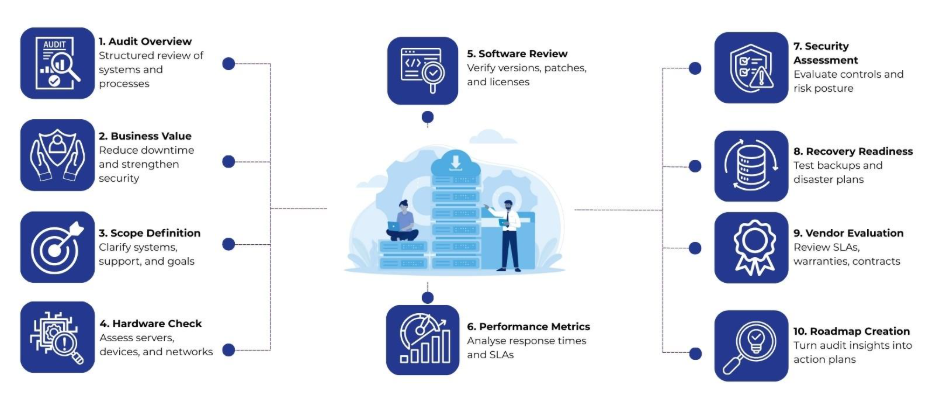
An IT Infrastructure Support audit is a systematic review of your hardware, software, networks, security frameworks, and operational processes. Its objective is to evaluate:
- Performance and reliability
- Security posture
- Scalability and readiness for growth
- Cost efficiency
- Compliance with regulatory and internal standards
Unlike general IT audits, this process focuses specifically on the support structure, i.e., help desk operations, issue resolution workflows, monitoring systems, vendor management, and disaster recovery readiness.
Why Auditing IT Infrastructure Support Matters
A structured audit delivers measurable business value. Here’s what it helps you achieve:
- Reduced downtime: Identifies weak points before they cause outages
- Better cybersecurity: Highlights misconfigurations and outdated controls
- Improved service delivery: Refines response times and user satisfaction
- Optimized IT spending: Eliminates wasted licenses and underused assets
- Regulatory alignment: Supports compliance with standards like ISO 27001, IT Act, 2000, etc.
As organizations expand their digital footprint, the complexity of IT Infrastructure Support grows. Audits act as a stabilizing force in this expanding ecosystem.
Step 1: Define the Scope and Objectives of the Audit
Every successful IT audit starts with clarity. Begin by defining:
1. Systems to Be Covered
- Servers and data centers
- Cloud platforms
- Network infrastructure
- End-user devices
- Backup and disaster recovery tools
2. Support Functions to Review
- Service desk operations
- Incident and problem management
- Change management
- Vendor and SLA oversight
- Asset management
3. Key Business Goals
- Improving uptime
- Strengthening security
- Cutting operational costs
- Preparing for scalability
Clear objectives prevent scope creep and keep the audit focused on business outcomes.
Step 2: Assess Hardware and Network Infrastructure
Your physical and virtual backbone deserves close attention.
Hardware Review Checklist
- Server performance and age
- Storage utilization
- Redundancy and failover setup
- End-user device lifecycle status
Network Review Checklist
- Bandwidth usage trends
- Network segmentation
- Firewall configurations
- VPN performance
Look for bottlenecks, single points of failure, and devices running past their recommended life cycle. Modern IT Infrastructure Support relies on proactive replacement instead of reactive repairs.
Step 3: Evaluate Software, Licensing, and Patch Management
Outdated software is one of the most common risk factors in IT environments.
Areas to Examine
- Operating systems and application versions
- License utilization vs. procurement costs
- Patch deployment frequency
- Automation in updates and rollouts
Unused licenses quietly drain budgets, while delayed patches expose systems to vulnerabilities. A thorough audit connects software usage data directly with financial and security outcomes.
Step 4: Review IT Infrastructure Support Performance Metrics
If performance is not being measured, it cannot be improved. Therefore, analyze service delivery using data, not assumptions.
Core KPIs to Track
- Mean Time to Respond (MTTR)
- Mean Time to Resolve
- First Contact Resolution (FCR)
- Ticket backlog
- SLA compliance rates
Compare current metrics with historical performance and industry benchmarks. This highlights patterns in recurring issues, staffing gaps, or workflow inefficiencies.
Step 5: Analyze Cybersecurity Controls and Risk Posture
Security is a foundational pillar of IT Infrastructure Support. An audit should test both defensive tools and operational discipline.
Security Areas to Audit
- Endpoint protection
- Identity and access management
- Multi-factor authentication
- Data encryption standards
- Security incident response workflows
- Log monitoring and SIEM tools
Also, review recent security incidents and how quickly they were handled. Weak response procedures can be as dangerous as weak security software.
Step 6: Examine Backup, Disaster Recovery, and Business Continuity
Downtime is costly, and data loss can be catastrophic. Yet, many organizations do not regularly test their recovery systems.
Key Review Points
- Backup frequency and retention policies
- Offsite and cloud backup coverage
- Recovery Time Objective (RTO)
- Recovery Point Objective (RPO)
- Frequency of recovery simulations
An audit verifies not just the presence of backups, but also their reliability under real-world stress conditions.
Step 7: Evaluate Vendor Management and Support Contracts
Vendors play a big role in IT Infrastructure Support. Poor contract management often leads to service delays and unexpected costs.
Review the Following
- SLA performance against agreed benchmarks
- Escalation paths and response commitment
- Software support renewals
- Hardware warranty timelines
- Hidden contract clauses
Strong vendor oversight improves accountability and stabilizes long-term IT planning.
Step 8: Inspect Documentation, Policies, and Compliance Readiness
Unstructured documentation weakens IT operations even when systems are modern.
Audit the availability and accuracy of
- Network diagrams
- Asset registers
- Support workflows
- Access control policies
- Data classification rules
- Incident response playbooks
Well-maintained documentation supports faster troubleshooting, smoother onboarding, and regulatory readiness.
Step 9: Identify Gaps, Risks, and Optimization Opportunities
Once data is collected, convert findings into actionable insights
- Categorize issues by risk level (critical, moderate, low)
- Highlight performance bottlenecks
- Pinpoint cost leaks
- Isolate security control gaps
- Identify automation potential
This step transforms raw audit data into a strategic improvement blueprint for your IT Infrastructure Support system.
Step 10: Formalize an Improvement Roadmap
An audit delivers value only when paired with action. Your final roadmap should include
- Technology upgrades
- Policy updates
- Staffing or training plans
- Vendor renegotiations
- Cybersecurity strengthening
- Automation adoption
Assign accountability, define timelines, and link each action to a measurable metric.
How Often Should You Audit IT Infrastructure Support?
For most organizations
- Full audit: Once every 12 months
- Security reviews: Every 6 months
- Performance health checks: Quarterly
High-growth companies or regulated industries may require more frequent audits based on operational risk levels.
Power Your Business with Trusted IT Infrastructure Support from Nurture IT
Auditing your systems is only the first step. Turning insights into performance-driven results requires the right technology partner—and that’s where Nurture IT makes the difference.
Nurture IT delivers end-to-end IT Infrastructure Support designed to strengthen security, boost system availability, and streamline daily operations. From proactive monitoring and cloud optimization to network management, cybersecurity, and disaster recovery planning, Nurture IT builds resilient IT environments that grow with your business.
Why Businesses Choose Nurture IT
- Proactive IT Monitoring: Issues get detected and resolved before they disrupt operations
- Scalable Infrastructure Solutions: Built for startups, mid-sized businesses, and large enterprises
- Advanced Cybersecurity Frameworks: Strong protection across endpoints, networks, and cloud platforms
- Expert Service Desk Support: Faster resolution times and improved user experience
- Strategic IT Consulting: Technology decisions backed by real business goals
Whether you’re modernizing legacy systems, strengthening cloud infrastructure, or refining your IT Infrastructure Support strategy after an audit, Nurture IT delivers reliable solutions driven by expertise and innovation.
Ready to transform your IT operations? Partner with Nurture IT in Indiranagar and build a smarter, stronger digital foundation today.
FAQs
1. What is the main goal of an IT Infrastructure Support audit?
The primary goal is to evaluate performance, security, reliability, and cost efficiency across all support systems and processes.
2. Who should conduct the audit?
Internal IT teams can handle routine reviews, while third-party auditors offer unbiased risk assessments and compliance validation.
3. Does an audit disrupt daily IT operations?
Most audits run in parallel with normal operations and cause minimal disruption when properly planned.
4. Is cloud infrastructure included in IT Infrastructure Support audits?
Yes, cloud platforms, virtual networks, identity systems, and cloud security controls are all core audit components.