How Predictive Analytics Prevents IT Downtime and Disruptions
Imagine a bustling e-commerce giant on Black Friday, servers humming like a well-oiled machine, when suddenly—bam!—everything grinds to a halt. Customers stare at error pages, revenue evaporates, and IT teams scramble in panic mode. We’ve all heard stories like this, from airline systems crashing mid-flight bookings to social media blackouts that leave billions disconnected. But what if these catastrophes could be foreseen and sidestepped? Enter predictive analytics, the crystal ball of modern technology, embedded within data-driven IT solutions that turn potential disasters into mere blips on the radar.
In this blog, we’ll discuss how predictive analytics saves businesses time, money, and reputation.
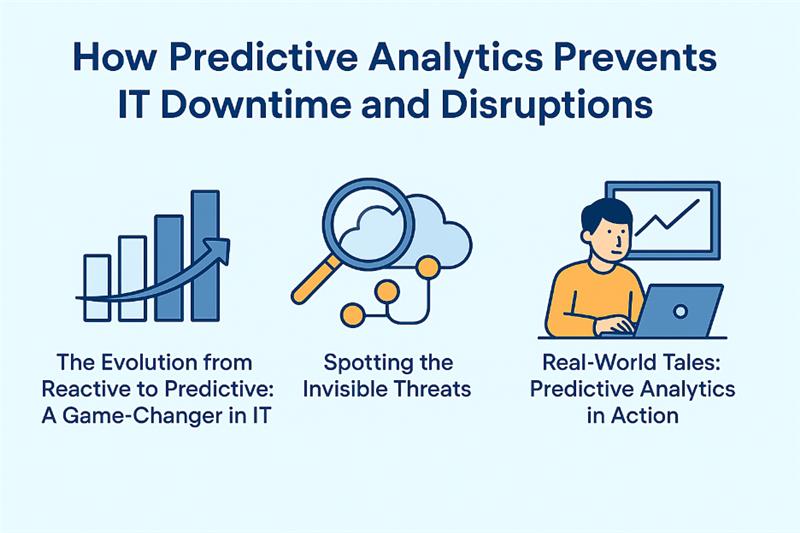
The Evolution from Reactive to Predictive: A Game-Changer in IT
In the old days, teams played reactively, waiting for a server to fall before making a move. However, it often led to prolonged outages, with average downtime costing companies even lakhs. However, data-driven IT solutions flip the script by introducing predictive analytics.
Predictive analytics works by analyzing real-time and historical data streams. AI-powered monitoring platforms collect metrics from across the infrastructure—CPU usage, memory leaks, disk I/O rates—and apply models to detect anomalies. For example, if a server’s temperature creeps up unusually over time, the system flags it as a potential overheating risk, prompting preemptive cooling adjustments or part replacements. Algorithms like regression analysis or neural networks crunch the numbers and identify correlations that humans might miss.
What makes this fascinating is the storytelling aspect of data. Each log entry or performance metric narrates a tale of system health. Data-driven IT solutions weave these narratives into actionable insights. Think about a telecom company watching its network traffic: Predictive models can figure out when congestion will spike, so they can reroute data ahead of time. The result? Seamless connectivity, no dropped calls, and happier customers. By moving beyond mere monitoring to foresight, these solutions transform IT from a cost center into a strategic asset.
Spotting the Invisible Threats
At the heart of data-driven IT solutions lies continuous monitoring, but it’s not just watching; it’s predicting. Sensors and agents embedded in hardware and software generate terabytes of data daily. Predictive tools sift through this deluge, using techniques like time-series forecasting to predict when a component might fail.
Take hardware failures, a common culprit behind outages. Traditional maintenance schedules part replacements on fixed intervals, often too early (wasting resources) or too late (leading to breakdowns). Predictive maintenance, powered by data-driven IT solutions, addresses this issue.
For example, vibration sensors on servers collect data that feeds into models predicting bearing wear in fans or drives. If the model detects irregular patterns suggesting a potential failure in two weeks, technicians can intervene precisely when needed. This proactive approach has been shown to reduce unplanned downtime by up to 50% in manufacturing environments.
Software bugs and cyber threats add another layer of intrigue. Predictive analytics scans code repositories and runtime behaviours for vulnerabilities. Besides, machine learning models trained on past incidents can identify subtle signs of malware infiltration, like unusual API calls or data exfiltration attempts. For example, a financial institution can use such tools to detect a zero-day exploit attempt hours before it can encrypt their databases and avert a ransomware nightmare.
Network disruptions, often triggered by overloads or configuration errors, benefit immensely too. Data-driven IT solutions employ graph analytics to map dependencies across clouds, on-prem servers, and edge devices. By simulating scenarios, they predict bottlenecks and suggest optimizations, like auto-scaling resources in cloud environments. This proactive stance keeps e-commerce sites responsive during flash sales or streaming services buffer-free during binge-watching marathons.
The beauty here is scalability. Small startups to global enterprises can adopt these solutions via cloud-based platforms, democratizing access to predictive power. No longer reserved for tech titans, data-driven IT solutions empower any organization to foresee and forestall IT hiccups, turning potential chaos into controlled calm.
Real-World Tales: Predictive Analytics in Action
To make this tangible, let’s zoom in on some real-world examples where data-driven IT solutions have shone brightly. In the aviation industry, where downtime can ground fleets and strand passengers, major companies like Lufthansa, Delta, and others have integrated predictive analytics into their operations. By analyzing engine data from flights in real-time, their systems predict mechanical issues with remarkable accuracy.
In healthcare, hospitals rely on IT for everything from electronic health records to life-support machines. Data-driven IT solutions here use predictive models to monitor server health. For example, major hospital networks in India have started using AI to analyze usage patterns and predict when database overloads might occur during peak admission times. This foresight helps them balance the load, so systems stay up and running and patient data is always accessible.
These stories aren’t outliers; they’re becoming the norm. According to industry reports, organizations adopting predictive analytics see a 20-30% drop in IT incidents. The key takeaway? Data-driven IT solutions don’t just prevent downtime—they help businesses to thrive amid uncertainties.
Final Thoughts
In a world where IT underpins every facet of business, predictive analytics shines as a game-changer. It helps businesses avoid downtime and disruptions by predicting potential failures, optimizing resources, and learning from past data. Those who adopt predictive analytics don’t just stay afloat—they thrive, turning uncertainties into opportunities for growth.
Want to stay ahead of the curve in IT? Discover how Nurture IT transforms business operations with data-driven IT solutions. Contact us today!
FAQs
1. What is predictive analytics in IT?
Predictive analytics in IT uses historical and real-time data to forecast potential system issues, allowing businesses to address problems before they impact operations.
2. How does predictive analytics help prevent IT downtime?
By identifying anomalies in system behaviour, predictive analytics can anticipate hardware failures, software bugs, or network disruptions.
3. What types of data are used in predictive analytics for IT systems?
Predictive analytics uses data such as CPU usage, memory leaks, disk I/O rates, vibration sensors, and network traffic to forecast potential IT failures or performance issues.
4. Can predictive analytics detect hardware failures before they happen?
Yes, by using sensors and real-time data, predictive analytics can identify irregular patterns in hardware components, such as overheating or wear, enabling preemptive maintenance.
5. How does predictive analytics optimize resource allocation in IT?
Predictive analytics can forecast demand and usage patterns, helping IT teams allocate resources more effectively and avoid overloading systems, especially during peak traffic times.